Comprehending Peptide Purity: What 99%+ Actually Means
Peptide Pureness Determination Innovative Peptides-peptide Medication Discovery
Measuring peptide purity is commonly finished with analytical high-performance liquid chromatography (HPLC), often paired with mass spectrometry (MS) for identification verification. These logical methods are typical in peptide quality control and you will almost always get HPLC and MS data with a study peptide order. The main logical approaches for peptides consist of liquid chromatography (LC), normally HPLC, combined with mass spectrometry (MS) for exact molecular weight decision and series validation.Additionally, bear in mind that "research-grade" peptides are indicated for the laboratory bench and include high purity and identity checks however are not generated as medications. Always examine that your peptide includes proper analytical information (HPLC chromatogram and MS outcomes) and is classified for study usage. Armed with this knowledge, you can confidently analyze labels like "95% purity, research study quality" and make use of those peptides to drive your experiments without confusion. Understanding of purity levels will certainly likewise guide you if you ever before require a higher pureness peptide for a particularly sensitive assay. In the long run, getting the purity level right indicates a lot more dependable scientific research-- which's the best goal for any researcher. With years of logical screening experience and progressed tool platforms, BOC Sciences supplies comprehensive peptide quality testing solutions throughout the whole process from resources to formulas.
One of the most rigorous grade, involving careful HPLC filtration-- in some cases numerous rounds-- and strenuous QC. Required for measurable researches, architectural biology, in vivo research designs, and any application where also percentages of pollutant might affect outcomes. This is the quality where the boost most dramatically, since attaining that last 1-- 3% of purity requires throwing out a significant portion of the manufactured product. A deletion peptide missing out on a single deposit might still bind to the same receptor, but with various fondness or selectivity. In concentration-response experiments, these impurities can shift contours, squash plateaus, or present biphasic actions that covers real activity of the target compound. The isoelectric point (specialty) is a critical criterion for recognizing peptide solubility and actions in various environments.Certifications Of Analysis: How To Review And Interpret Laboratory Records
Each peptide has actually a different expected molecular weight, so mass confirmation is not a common badge; it is compound-specific evidence. For a much deeper identity-focused description, see Mass Spectrometry Peptide Confirmation. Identity testing validates that what was synthesised is in fact the designated sequence.- Examining allows researchers to understand precisely what remains in the vial, validating both identity and top quality.
- If you have actually ever acquired an artificial peptide for a laboratory experiment, you've likely observed a purity percent on the certification of evaluation-- usually worths like 95%, 98%, or even 99%.
- Making certain that each set undergoes proper lab screening helps confirm the peptide's credibility and pureness, which is important for both research legitimacy and safety.
- We can give specialist peptide pureness determination solutions making use of analytical reversed-phase HPLC combined with mass spectrometry.
- Not every application needs 99% pureness, and purification is a significant part of peptide production expense.
- Products are for in-vitro laboratory research use only and are except human intake.
FDA and the European EMA have developed standards mandating extensive analysis and quality control for peptide products to ensure safety and security and effectivenessr. In the context of pharmaceutical or clinical-grade peptides, research laboratory validation is integral to satisfying these standards. For instance, before a peptide medication can go into human tests, its manufacturer has to demonstrate the identity, pureness, potency, and safety and security of the peptide through validated logical techniques. Peptide purity testing information are required in preclinical research studies and should be included in investigational new drug (IND) applications and later brand-new drug applications (NDAs).
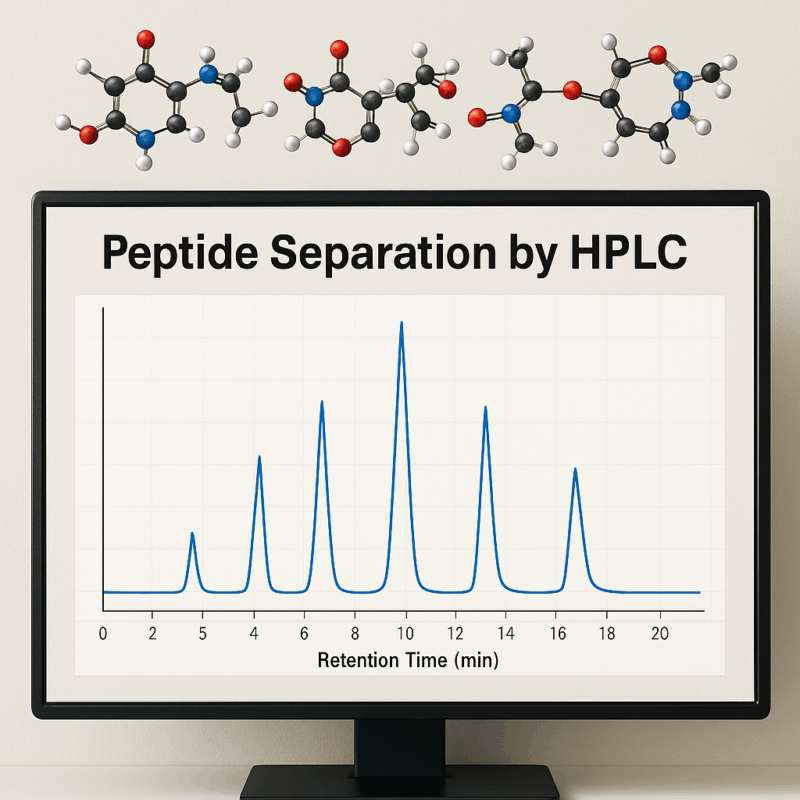
Reviewing An Hplc Chromatogram
The pureness of peptides is usually examined using high-performance fluid chromatography (HPLC). HPLC separates peptides based on their interactions with a stationary phase, allowing pollutants and spin-offs to be identified and measured. Furthermore, mass spectrometry (MS) can be made use of to verify the peptide's molecular weight and series, giving further confirmation of pureness by detecting impurities and deterioration items. If you have actually ever gotten a synthetic peptide for a lab experiment, you have actually likely observed a purity percent on the certificate of analysis-- generally worths like 95%, 98%, Pharmaceutical Grade Peptides and even 99%. Peptide purity is an essential top quality metric that informs you what fraction of a peptide example is the designated product versus undesirable byproducts.
Residuals Testing
This front-end evaluation minimizes rework and improves the opportunity that the first analytical pass will certainly already be decision-useful. A modern-day HPLC system consists of several integrated parts, each serving a specific feature in the splitting up and discovery process. Join over 5,000 active participants and get updates on new arrivals and most current lab reports. In The KnowGet access to our magazine, new arrivals, and most current laboratory reports.
We can provide specialist peptide pureness determination solutions using logical reversed-phase HPLC paired with mass spectrometry. Each peptide is rigorously kept an eye on throughout the logical cycle according to rigid analytical quality assurance and biosynthetic quality control requirements. HPLC is outstanding at responding to the question "exactly how pure is this example by chromatographic location percent? " It does not, on its own, confirm that the primary top is the desired peptide. 
Corrections
Spot something wrong? Send it to the desk and it gets fixed in the open.